Signed in as:
filler@godaddy.com
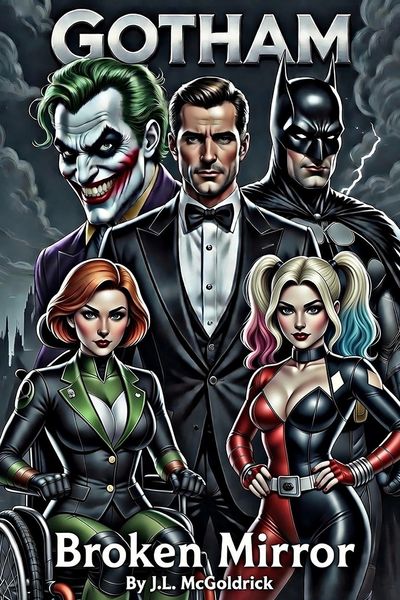
In the shadowed underbelly of Gotham, where the rain-slicked streets gleamed like the edge of a knife, Batman perched on a gargoyle atop Wayne Tower. His cape billowed in the wind, a dark shroud against the neon haze. Below, the city pulsed with its usual madness, but tonight felt different—charged, like the air before a storm. Oracle’s voice crackled in his ear: “Joker’s been quiet too long. And Harley’s with him. Last sighting: an abandoned carnival on the outskirts.”
Batman grunted, gliding down into the night. The carnival loomed like a forgotten nightmare, its faded tents sagging under years of neglect. Rusted Ferris wheels creaked in the breeze, and the faint echo of laughter—maniacal, unhinged—drifted from the big top.
Inside, the Joker lounged on a makeshift throne of broken clown statues, his green hair slicked back, his smile a slash of red. “Ah, Gotham’s favorite party pooper! Right on time,” he cackled, twirling a cane topped with a grinning skull. Beside him, Harley Quinn bounced on her toes, pigtails swinging, mallet slung over her shoulder. “Mistah J! Batsy’s here! Can I play?” she purred, her Brooklyn accent thick with glee.
Batman stepped into the ring of flickering lights, his voice a gravelly warning. “This ends tonight, Joker. Whatever scheme you’ve cooked up”
“Scheme? Oh, Bats, you wound me!” Joker leaped up, his purple suit immaculate despite the dust. “This is art! A masterpiece of chaos. Harley, dear, show him the canvas.”
Harley giggled, flipping a switch. Spotlights blared, revealing a web of tripwires connected to explosives rigged around the tent. But that wasn’t all—strapped to a comically oversized seesaw in the center was a kidnapped and hoodwinked Commissioner Gordon, teetering precariously. “One wrong move, and boom! Gordy’s goin’ sky-high!” Harley cheered, blowing a kiss at Batman.
The Dark Knight’s eyes narrowed. He had faced this duo before—the Joker’s twisted genius paired with Harley’s acrobatic fury made them a lethal cocktail. “Harley, you don’t have to do this. He’s using you.”
“Aw, jealous much?” Harley cartwheeled closer, her red-and-blue harlequin outfit a blur. She swung her mallet playfully, but Batman dodged, countering with a batarang that grazed her arm. She yelped, more in surprise than pain. “Hey! That stung, Bats!”
Joker howled with laughter. “See? Even the Bat’s got a soft spot for my girl. But enough chit-chat—let’s dance!” He hurled a handful of razor-sharp playing cards, forcing Batman to flip away. The fight erupted: Harley somersaulted into the fray, her mallet clashing against Batman’s gauntlets, while Joker darted in and out, planting acid-squirting flowers and laughing gas bombs.
Batman disarmed Harley with a swift kick, sending her sprawling. “It’s over,” he growled, advancing on Joker. But Harley wasn’t done. “Nobody hurts my puddin’!” She tackled him from behind, her nails raking his cape. In the struggle, a tripwire snapped—explosives hissed to life. Joker grinned maniacally. “Whoops! Tick-tock, Bats!”. With seconds to spare, Batman fired a grapnel line, yanking Gordon free just as the seesaw collapsed. The tent erupted in flames, but he shielded Harley instinctively, pulling her from the blast. Joker vanished into the smoke, his laughter echoing: “Until next time, old friend!”
As sirens wailed in the distance, Harley stirred in Batman’s arms, dazed. “Brucie, Why’d you do that again… save me?” she quietly murmured in his ear. “Because Gotham needs saving - Harley, you need saving” he replied, releasing her from his arms, she vanishing into the night. But deep down, he knew the cycle would continue: hero, villain, and the wild card in between.
In the shadowed halls of Gotham’s underbelly, where the line between sanity and madness blurred like ink in rain, young Bruce Wayne found himself adrift. It was 1995, and the alley behind the Monarch Theater still haunted his dreams—the pop of gunfire, the pearls scattering like broken promises, his parents’ lifeless forms crumpling to the cold pavement.
At eight years old, he was an orphan, heir to a fortune but prisoner to grief. Alfred, his steadfast butler with a face etched in lines of quiet duty and eyes that held the wisdom of lost battles, insisted on help, and so Bruce was shuttled to Arkham Asylum’s child psychiatry wing, a place where even the walls seemed to whisper secrets, their peeling paint and flickering fluorescent lights casting long, eerie shadows.
Dr. Marilyn Quinzel greeted him in her office, a room cluttered with crayons, stuffed animals, and faded posters of smiling families under the harsh glow of a desk lamp. She was a woman in her forties, with sharp eyes behind horn-rimmed glasses and a warm smile that hid the exhaustion of battling Gotham’s fractured minds, her posture straight but shoulders slightly slumped from years of carrying others’ burdens. “Bruce, sweetheart,” she said, her voice soft like a lullaby, “trauma is a heavy cloak, but we can learn to shed it. You’re not alone here.”
It was during these sessions that Bruce met Harleen Quinzel, Dr. Quinzel’s own daughter, a spirited nine-year-old with pigtails and a tomboy’s scrape on her knee, her face round and freckled with wide, curious eyes that sparkled with mischief. Harleen—or Harley, as she insisted on being called—was there for her own reasons: a father who drank too much, a home that echoed with arguments. She drew pictures of acrobats and jesters, her laughter a bright spark in the dim asylum, her small frame always in motion, bouncing on her toes or cartwheeling across the scuffed linoleum floors.
Bruce, usually silent and brooding with his dark hair falling over his forehead and a stance that already hinted at the guarded man he’d become, found himself opening up to her. They’d sneak notes under the table during group playtime, sharing stories of imaginary adventures. “You’re like a knight,” she’d say, giggling, her pigtails swinging. “All serious and stuff.” And Bruce would almost smile, feeling a rare warmth in his chest. They became inseparable, two kids forging a bond in the crucible of pain.
But Dr. Quinzel’s methods were unconventional, even controversial among her peers. She treated a small group of children, including Bruce, Harley, and another boy named Joseph Kerr—Joe, a wiry ten-year-old with wild green-tinted hair (from a prank gone wrong, he claimed) and a laugh that could curdle milk, his thin face marked by a perpetual smirk and eyes that darted like they were always plotting. Joe’s family was a mystery; whispers said his parents had abandoned him after a circus accident left him scarred.
Dr. Quinzel believed in “alter ego therapy,” a radical approach where children transferred their trauma to fictional personas. “Imagine a savior,” she’d explain, her voice earnest as she adjusted her glasses. “Someone who takes the hurt away, who fights the monsters so you don’t have to. It’s like giving your pain a mask to wear.”
In one pivotal session, the three children sat around a low table in the therapy room, the air thick with the scent of crayons and antiseptic. Rain pattered against the barred windows, casting flickering shadows across the yellowed walls and the scattered toys in the corners. Dr. Quinzel passed out paper and boxes of colors. “Draw your savior,” she instructed gently. “Let it be whatever you need—a hero, a trickster, anything. Pour your fears into it, and watch them transform.”
Bruce hunched over his sheet, his small hands gripping a black crayon, his young face furrowed in concentration. He sketched a towering figure, cloaked in darkness, with pointed ears like a bat’s wings and eyes that pierced the night. It was intimidating, a guardian born from the alley’s horrors—strong, silent, unyielding. “He protects the innocent,” Bruce murmured, adding jagged lines for a cape. “No one else has to die.”
Joe, across from him, cackled softly as he worked, his skinny arms moving in erratic bursts. His drawing erupted in chaotic bursts: clowns with smeared makeup, grins stretched too wide, eyes hollow and mocking. But there was a sinister twist—their hands clutched knives, their outfits splashed with what looked like blood-red polka dots. “Mine’s a joker,” Joe said, his voice high and unsteady, his stance slouched but alert. “He laughs at the pain, turns it into a game. Boom—everything’s funny when it’s broken!” Dr. Quinzel nodded approvingly, but Bruce caught a flicker of concern in her eyes.
Harley, sandwiched between them, glanced at both boys’ papers with wide-eyed curiosity, her pigtails bobbing as she tilted her head. Her creation was a fusion, bold and vibrant: a strong feminine tomboy in red-and-black diamonds, wielding a massive mallet like a knight’s sword. She had pigtails like Harley’s own, but with a clown’s flair—mischievous, acrobatic, unbreakable. “She’s tough like your bat guy, Bruce,” Harley said, beaming at him, “but fun like Joe’s clowns. She flips the bad stuff upside down and smashes it!” The three shared a tentative laugh, their drawings laid out like blueprints for futures they couldn’t yet fathom.
As weeks turned to months, the therapy deepened. Dr. Quinzel encouraged role-play, where the kids embodied their alter egos in safe, controlled games within the asylum’s echoing rec room, its high ceilings and barred windows making every sound reverberate. Bruce’s “Bat” became his shield, a way to channel rage into justice. Joe’s “Joker” grew wilder, his pranks escalating from harmless jokes to ones that left the nurses uneasy. And Harley’s “Harlequin” evolved into a whirlwind of loyalty and chaos, often defending her friends in their pretend battles.
But the plot twisted one stormy evening when Joe overheard Dr. Quinzel in a heated argument with asylum administrators in her office, the rain lashing the windows like angry fingers. “These children are experiments?” a voice barked. Joe, eavesdropping from the vents (a habit he’d picked up), learned the truth: Dr. Quinzel’s therapy wasn’t just innovative—it was funded by shadowy Gotham figures interested in “mind control” techniques. She wasn’t curing them; she was unwittingly planting seeds for something darker, transferring trauma not to heal, but to create fractured psyches ripe for manipulation.
Joe confronted her in secret, his young face twisted in betrayal. “You made us into monsters!” he hissed. In a panic, Dr. Quinzel tried to explain, but Joe fled into the night, vowing revenge. That same night, Harley discovered her mother’s notes—detailing how the alter egos could “evolve” into coping mechanisms or, in worst cases, dissociative identities. Horrified, she confided in Bruce, tears streaming down her freckled cheeks. “What if we’re broken forever?”
Bruce, drawing on his budding resolve, promised to protect her. But as Joe vanished into Gotham’s streets, adopting his “Joker” persona for real, the seeds of destiny were sown. Years later, those childhood drawings would manifest: Bruce as the Dark Knight, Harley torn between love and madness, and the Joker as chaos incarnate. Their friendship, forged in crayons and pain, would become a tragic web—heroes and villains intertwined, each a reflection of the others’ shattered souls.
In the neon-drenched sprawl of Gotham City, 2025 dawned like a false promise—crime rates plummeted to historic lows, the streets echoing with an unnatural quiet under the flickering streetlights and billboards touting “A Better Gotham.” The Bat-Signal, once a nightly beacon, gathered dust on the GCPD rooftop. Bruce Wayne, now in his late forties with silver threading his dark hair and a stance that spoke of unyielding vigilance, paced the Batcave, his jaw set in grim determination. Monitors flickered with news feeds: muggings down 95%, organized crime syndicates dissolving like smoke. It was too clean, too perfect. And at the center of this eerie calm? His old “friends.”
It started with a viral X post—formerly Twitter, but rebranded in the chaos of the digital age. The account @JokerAndHarleyOfficial, verified with a blue check mark, dropped a bombshell video that racked up millions of views in hours. The Joker, his once-ghastly pale face now tanned and groomed, sat beside Harley Quinn in a sleek, minimalist office overlooking the city, floor-to-ceiling windows framing the skyline like a painting. Gone was his purple suit; he wore a tailored charcoal ensemble, his green hair slicked back into a respectable fade, his posture relaxed but with that underlying twitch of mania. “Folks,” he drawled, that signature cackle softened to a chuckle, “the punchline’s on us. We’ve seen the error of our ways. No more capers, no more chaos. We’re goin’ straight—building a better Gotham, one laugh at a time.”
Harley leaned in, her transformation even more striking. The heavy makeup and risqué harlequin getup had vanished, replaced by a fashion-model-meets-business-professional aesthetic: a sharp blazer in midnight blue over a crimson silk blouse, paired with high-waisted trousers and heels that clicked with authority. Subtle hints of her past lingered—a red-and-blue enamel pin on her lapel, earrings dangling like tiny diamonds in harlequin patterns. And always, that fire-red lipstick, a bold slash against her poised smile, her face framed by loose waves of blonde hair and eyes that sparkled with genuine conviction. “We’ve got big plans, puddin’—er, everyone,” she corrected with a wink. “A new wing at Gotham Children’s Hospital for the little ones who’ve been through hell. A clinic for battered spouses, ‘cause no one should feel trapped. We’re turnin’ our pain into purpose.”
Social media exploded. Hashtags like #JokerRedemption and #HarleyHero trended worldwide. Influencers praised their “glow-up,” celebrities donated in solidarity, and memes flooded feeds: Joker as a motivational speaker, Harley as a TED Talk icon. Comments poured in: “If the Joker can change, anyone can!” and “Harley’s new look is FIRE—empowerment goals!” Behind the screens, donations surged, funding the projects that Harley fronted with grace. She cut ribbons at groundbreaking ceremonies, her speeches raw and inspiring: “I know what it’s like to be broken. But you can rebuild.” The public ate it up, blind to the shadows.
But Batman knew better. Whispers reached him through Oracle’s network—strange upticks in crime elsewhere. In Tokyo, a crew called the “Shadow Owls” orchestrated high-tech heists, silent as night, leaving riddles carved into vault doors. In London, the “Midnight Coyotes” ran extortion rackets, howling laughter echoing through fog-shrouded alleys. Sydney’s “Nocturnal Bats”—a cruel irony—smuggled artifacts under cover of darkness. Each group themed around nocturnal animals: elusive, predatory, striking when the world slept. And the patterns? Too familiar—chaotic yet calculated, with a twisted humor that screamed Joker.
“They’re decoys,” Batman growled to Alfred over comms, suiting up for the first time in months in the Batcave’s cavernous depths, where bats fluttered in the high ceilings and the hum of computers provided a constant backdrop. “He’s clearing Gotham to build his empire elsewhere. Proving it will be the challenge.” Crime in Gotham had vanished not by miracle, but by design—the Joker’s old networks dismantled, resources funneled outward. Batman vanished into the night, jetting to Tokyo first. There, he infiltrated an Owl lair amid the neon-lit streets and towering skyscrapers, dismantling their operation in a brutal ballet of shadows and gadgets. Feathers scattered like confetti, but no direct link to Joker. London next: Coyotes cornered in the Underground, their howls silenced amid the echoing tunnels and flickering tube lights. Still, evidence slipped through his fingers—burner phones with encrypted laughs, symbols that mocked him.
As Batman globe-trotted, frustration mounted. Each takedown felt like punching fog; the crews reformed elsewhere, in Berlin’s “Eclipse Wolves” or Rio’s “Twilight Jaguars.” Social media painted him as the villain now: “Batman’s gone rogue—chasing ghosts while Joker’s saving kids?” Viral clips showed Harley at the hospital wing’s opening, hugging wide-eyed children in a brightly lit ward with colorful murals on the walls, her red lipstick leaving smudges of hope on their cheeks. “We’re healing Gotham,” she’d say, eyes sparkling with what seemed like genuine tears. But Batman caught the subtext in her posts—a faint blue-red filter on photos, a cryptic emoji of a bat and a jester. Was it a taunt? A plea?
Deep down, doubts gnawed at him. Flashes of childhood sessions resurfaced: crayons scribbling saviors in the dim therapy room, Dr. Quinzel’s voice urging release. Joe Kerr’s wild laughter blending with his own. Harley knew something— she always had, that bond from Arkham’s halls unbreakable. In quiet moments, Batman wondered if the real monster wasn’t out there, but within. But he pushed on, racing against the world’s adoration, determined to shatter the illusion before the Joker’s global web ensnared them all.
As Batman’s global crusade intensified, the first fissures in his ironclad psyche began to appear—subtle at first, like hairline cracks in a mirror, distorting reflections just enough to unsettle. It started in Berlin, under the cover of a moonless night in the city’s industrial district, where fog rolled off the Spree River and streetlights cast long, wavering shadows. The Eclipse Wolves, a crew of masked operatives themed around lupine shadows, targeted the vaults of a high-security bank with steel doors and laser grids humming in the dimly lit corridors. Batman had tracked them via encrypted chatter, arriving in a swirl of cape and fury. But the timing gnawed at him: he swooped in mere seconds after their breach, as if synchronized. Explosives detonated not to destroy, but to endanger civilians—a collapsing atrium trapping innocents under rubble amid the bank’s marble floors and echoing halls.
Prioritizing lives, Batman diverted from the chase, grappling lines firing to pull victims free. “Get out—now!” he barked, his voice a thunderclap. The Wolves slipped away with digital ledgers of laundered funds, their howls mocking in the distance. By morning, cellphone footage flooded social media: edited clips, clickbait thumbnails screaming “Batman Aids Heist?!” Spliced angles showed him “clearing paths” for the crew, his heroic saves twisted into complicit distractions. Comments erupted: “Is the Bat in on it? #BatmanBetrayal” and “Gotham’s vigilante gone rogue—protecting thieves over us?”
The pattern repeated in Rio, with the Twilight Jaguars raiding a museum filled with ancient artifacts under spotlights in ornate halls. Batman landed on the rooftop precisely as alarms blared, his presence feeling eerily prescient. A rigged exhibit collapsed, endangering tourists; he saved them, but the Jaguars vanished with priceless artifacts. More videos surfaced—grainy, manipulated: Batman “signaling” the crew, his batarangs “missing” on purpose. Public sentiment shifted; polls on X showed approval for Joker and Harley’s reforms soaring, while Batman’s plunged. Whispers grew: “Wherever the Bat goes, chaos follows. Gotham’s peaceful without him.”
Back in the Batcave, Bruce Wayne shed the cowl, his reflection in the monitors fractured by doubt. Flashes assaulted him—childhood echoes of Joe’s laughter merging with his own, Dr. Quinzel’s voice murmuring about alter egos. “Am I… losing it?” he muttered, rubbing his temples. The correlation stung: crime spiked in cities he visited as Batman or even as Bruce (under guises for Wayne Enterprises dealings), while Gotham basked in unprecedented tranquility. Social media sleuths connected dots: “Bruce Wayne in Berlin same day as heist? Coincidence? #WayneConspiracy”
Desperate for clarity, Bruce convened his allies. Oracle—Barbara Gordon, her holographic avatar flickering in the cave, her red hair tied back and face marked by determination—nodded gravely. Alfred, ever the pillar with his crisp suit and steady gaze, poured a steadying scotch. “We need to follow the money,” Bruce said, voice strained. “Trace the crews’ hauls back to Joker. Prove he’s the puppet master.” Oracle’s fingers danced over virtual keys: “On it. Shell companies, offshore accounts—I’ll peel the layers.” Alfred added, “I’ll cross-reference with Wayne Enterprises’ global ledgers, Master Bruce. Discreetly, of course.”
Weeks dragged into a slow-burning investigation, each dead end chipping at Bruce’s resolve. Oracle uncovered initial trails: Wolves’ funds funneled through a Berlin-based “Lunar Logistics,” Jaguars’ loot to a Rio “Night Prowl Imports.” Patterns emerged—nocturnal themes, cryptic Joker-esque riddles in transaction notes. But as they dug deeper, anomalies surfaced. A transfer looped back to a Gotham charity—oddly, one tied to Harley’s clinic. Alfred frowned over ledgers in the manor’s study, surrounded by leather-bound books and the crackle of a fire: “These shells… they mimic the Joker’s flair, but the routing is sophisticated. Almost too perfect.”
Bruce pushed on, but the cracks widened. Nightmares blurred lines: him as Joker, laughing in mirrors. Public backlash mounted—protests outside Wayne Tower, chants of “Bat Out!” And still, the money trail twisted, inching closer to an unthinkable truth, hidden in layers of deception that would shatter everything.
In the opulent penthouse atop Quinzel Tower—a gleaming spire funded by their “philanthropic” ventures, with panoramic views of the twinkling city lights and modern furniture in shades of red and black—the Joker lounged on a velvet chaise, a glass of sparkling water (no more toxins, for appearances) in hand. The city lights twinkled below like captured stars, but his eyes gleamed with a sharper malice. Harley stood by the floor-to-ceiling windows, her new look impeccable: a tailored red blazer over a blue silk dress, fire-red lips pursed in what she hoped passed for a smile. She fiddled with a diamond necklace, a subtle harlequin pattern etched into its pendant, her stance poised but with a subtle tension in her shoulders.
“Ah, Harls, my reformed queen,” Joker purred, his voice a silky drawl stripped of its old hysteria—for now. He gestured at the holographic display floating between them, mapping out the global crews: Owls in Tokyo, Coyotes in London, Wolves in Berlin. “Look at it all clicking into place. Those nocturnal nuisances are bleeding the world dry, and every penny funnels back through shells that scream ‘Joker’—but oh, the punchline! It all traces to Wayne Enterprises. Brucey’s little empire, crumbling under his own weight.”
He chuckled, low and satisfied, swirling his drink. “Batman’s chasing shadows, saving the day just enough to look like he’s in on the heist. Public’s turning—#BatmanBetrayal trending like wildfire. Soon, they’ll hound Wayne too. ‘Wherever he goes, crime follows!’ Delicious. We’ll watch him shatter, piece by piece—Batman unmasked as a fraud, Bruce bankrupt and broken. Gotham’s savior? Ha! He’ll be the villain in his own story.”
Harley forced a grin, her pigtails long gone but her bounce reflexive. “Yeah, puddin’—I mean, Mistah J—it’s genius! Those crews are runnin’ circles ‘round him. And our charity stuff? The kids’ hospital wing’s got everyone eatin’ outta my hand. We’re heroes now!” She clapped her hands together, the sound a bit too sharp, her eyes darting to the cityscape where Wayne Tower loomed in the distance. A flicker crossed her face—memories of crayon drawings, young Bruce’s quiet strength. She swallowed, adding brightly, “Destroyin’ Bats and Bruce… it’ll be epic. Totally.”
But her fingers tightened on the necklace, twisting it just a fraction too hard. Joker didn’t notice, too lost in his glee, but Harley felt the old pull—the girl from Arkham who once saw Bruce as a friend, not fodder. “Can’t wait,” she murmured, her enthusiasm a thin veil over the storm brewing inside.
In the dim glow of the GCPD’s war room, buried deep in the precinct’s fortified basement with concrete walls scarred by years of use and maps pinned haphazardly, the air hummed with tension. Holographic maps flickered on the central table, charting the global crime spikes and Gotham’s unnatural peace. Commissioner James Gordon, his mustache grayer than ever but his resolve unyielding, his broad shoulders squared in his rumpled suit, stood at the head, flanked by a cadre of GCPD officers. Across from him, shadows clung to Batman like a second skin, his silhouette imposing beside Alfred Pennyworth’s polished poise—Alfred’s face calm but eyes sharp—and Oracle’s digital avatar hovering via secure link—Barbara Gordon, her sharp eyes scanning feeds from the Batcave.
It was a rare alliance, born of desperation. “Batman’s being framed,” Gordon rumbled, lighting a cigarette despite the no-smoking signs, the smoke curling up to the low ceiling. “Those crews? Joker’s fingerprints all over ‘em. But the public’s buying his redemption act hook, line, and sinker. We need to pool resources—catch him, clear your name, save what’s left of this city’s faith in you.”
Batman nodded curtly, his voice a gravelly echo. “The money trail’s our key. Oracle and Alfred are tracing it, but it’s layered deep.”
Gordon gestured to a woman stepping forward from the shadows—a striking figure, 5’10” with reddish-brown hair cropped in a no-nonsense style that framed her light Irish skin and piercing blue-green eyes. She exuded confidence, her vibe subtle in the way she carried herself: tailored slacks, a crisp button-down under a leather jacket, badges of quiet authority. Detective Kelly Meleniez, about Barbara’s age—mid-forties, seasoned by Gotham’s grind, her stance alert and grounded—crossed her arms, her gaze appraising.
“This is Detective Meleniez,” Gordon introduced, a hint of pride in his tone. “She’s leading our task force on the Joker-Harley ‘reform.’ Sharp as they come—cracked the Falcone remnants last year. Kelly, meet the team: Batman, Alfred Pennyworth, and Oracle.”
Kelly shook hands firmly with Alfred, her grip testing, then nodded at Oracle’s hologram with professional courtesy. But her eyes lingered on Batman, a flicker of genuine respect there—trust, even. “I’ve followed your work for years,” she said, her voice smooth with a faint lilt. “You get results where we can’t. No badges, no bureaucracy—just justice. I trust that.”
Turning to Alfred and Oracle, however, her skepticism sharpened. “But this blind faith in Bruce Wayne? Wayne Enterprises popping up in every shadow lead we’ve got? He’s globe-trotting right when these heists hit, and crime follows him like a bad habit. You two vouch for him like he’s a saint, but facts don’t lie. If Joker’s pulling strings, Wayne could be a pawn—or worse.”
Alfred raised an eyebrow, unflappable. “Master Wayne is many things, Detective, but complicit in chaos? Preposterous.”
Oracle leaned in digitally, her tone defensive. “We’ve vetted him inside out. The trails are plants—Joker’s style. We join forces, we expose it together.”
Kelly paused, weighing the room. “Fine. United front. My team handles the street-level intel, you bring the tech and shadows. But if Wayne’s dirty, I won’t hesitate.” She locked eyes with Batman again, that trust holding firm. “Let’s nail the clown and pull you out of this mess.”
As strategies unfolded—shared databases, coordinated strikes—the alliance solidified, but undercurrents of doubt lingered, ready to fracture at the first misstep.
The grand ballroom of the Gotham Plaza Hotel shimmered under crystal chandeliers, a sea of black ties and glittering gowns swirling in a symphony of forced laughter and clinking champagne flutes. It was a fundraiser for the newly opened Quinzel Children’s Hospital Wing, drawing Gotham’s elite like moths to a flame. Bruce Wayne, impeccably tailored in a midnight-blue tuxedo, his dark hair neatly combed and face composed with that playboy charm masking his inner turmoil, navigated the crowd with disarming smiles and generous pledges. But beneath the facade, cracks were forming—bags under his eyes from sleepless nights, a slight tremor in his hand as he gripped his glass. Public opinion weighed on him like lead; headlines branded him a liability, Wayne Enterprises stock dipping amid whispers of conspiracy.
He hadn’t expected her. Harley Quinn—now Harleen Quinzel, philanthropist extraordinaire—glided through the throng, her presence electric. Her outfit was a masterclass in reinvention: a sleek, floor-length gown in deep crimson with subtle blue accents in the embroidery, hugging her figure with elegant poise, her blonde hair swept into a soft updo that accentuated her sharp cheekbones and sparkling eyes. No heavy makeup, just that signature fire-red lipstick and a subtle glow that made her look both approachable and untouchable. She was the evening’s star, shaking hands, sharing stories of the wing’s impact—how it had already helped kids like the ones she’d once been.
Their paths crossed near the silent auction table, an unexpected collision amid the murmur of conversations and the soft jazz from the band on stage. Bruce froze mid-conversation with a socialite, his eyes locking on hers. “Harleen,” he said, voice low, a mix of wariness and surprise.
“Bruce,” she replied, her Brooklyn lilt softened but unmistakable. A genuine smile tugged at her lips—not the manic grin of old, but something warmer, almost vulnerable. “Fancy meetin’ you here. Supportin’ the cause?”
He nodded, glancing at the crowd. Whispers followed them; phones subtly angled for photos. “It’s impressive work. The clinic, the hospital—it’s making a real difference.” He meant it; reports from Oracle confirmed it—lives saved, families mended. For a moment, doubt flickered in him: Was this change real? Her eyes held no malice, just a quiet determination he’d glimpsed in their childhood sessions.
Harley tilted her head, studying him, her posture graceful but with that tomboy energy in the way she shifted her weight. “Thanks. Means a lot, comin’ from you.” Her gaze sharpened, noticing the strain—the way his jaw clenched, the faint sheen of sweat on his brow despite the cool air. “You okay? Looks like the world’s been ridin’ you hard. All that noise online… it’s garbage, y’know? People forget who the real hero is.” There was concern there, subtle but real, a crack in her reformed armor. She saw the toll—the isolation, the paranoia eating at him.
Bruce forced a chuckle, but it rang hollow. “Just business as usual. Gotham’s always got its opinions.” Yet her words lingered, a balm on raw nerves. For the first time in weeks, he felt seen—not as the Bat or the billionaire, but as Bruce.
They stood in a bubble amid the chaos, memories surfacing like old drawings from a forgotten box. “Remember those crayons?” Harley murmured, her voice dropping. “Drawin’ our saviors. Mine was always a bit of yours and… well, you know.” A wistful smile, almost warm, bridged the years.
“Yeah,” Bruce admitted, a rare softness in his tone. “I do.” For a heartbeat, the fundraiser faded—their shared past a fragile thread, pulling them closer to something like understanding.
As the auctioneer called for bids, they parted with a nod, the air between them charged but not hostile. Almost warm, laced with remembrance.
In the cavernous depths of the Batcave, beneath Wayne Manor, the hum of supercomputers provided a constant, mechanical heartbeat. It was late—past midnight, the day after the fundraiser—and Oracle sat hunched over her array of monitors, her wheelchair positioned for optimal access, her red hair tied back in a practical ponytail and her face illuminated by the screens’ blue glow. Barbara Gordon’s fingers flew across holographic keyboards, sifting through layers of financial data like a digital archaeologist. The money trail from the global crews had been her obsession for weeks: shells within shells, nocturnal-themed dummies funneling funds in cryptic patterns. But tonight, as she cross-referenced with Wayne Enterprises’ internal ledgers, anomalies began to surface—subtle at first, then glaring.
“Wait… that’s not right,” Oracle muttered, zooming in on a transaction log. A transfer from “Lunar Logistics” in Berlin looped through an offshore account, then vanished into a Wayne subsidiary labeled as “R&D for Nocturnal Security Tech.” It was buried deep, encrypted with protocols only a handful of executives could access. She ran a diagnostic: no external breaches, no malware signatures. The alterations were seamless, as if woven into the fabric of the system itself. “This isn’t a hack,” she whispered, her brow furrowing. “It’s an inside job—or something mimicking one perfectly.”
She pulled up access logs: timestamps aligned with Bruce’s travels, but clearances tied to his own executive overrides. “Impossible,” she said aloud, her voice echoing off the stalactites. To manipulate these records required not just codes, but intimate knowledge of Wayne Enterprises’ proprietary AI safeguards—systems Bruce had designed himself. Only a select few could pull it off: Lucius Fox, perhaps, or Alfred with his backdoor privileges. Or Bruce. The thought sent a chill down her spine. “No outsider could do this without leaving a trace. It’s too… personal.”
The elevator whirred to life, descending with a soft hiss. Alfred Pennyworth emerged, tray in hand bearing a steaming pot of tea and sandwiches—his ritual for late-night vigils, his face composed but eyes weary from the day’s strain. “Miss Gordon,” he greeted, his British accent crisp despite the hour. “Burning the midnight oil again? You must eat; even digital warriors need sustenance.”
Oracle swiveled her chair, her expression grave. “Alfred, come look at this. I’ve been tracing the crews’ money—Owls, Coyotes, all of them. It leads right back to Wayne Enterprises, through shells that mimic Joker’s style: riddles in the code, nocturnal themes. But the integrations are too clean. No hack signatures, no forced entries. It’s like the system rolled out the red carpet. Only a handful of insiders could pull this off without tripping alarms: Bruce, Alfred, maybe Lucius Fox. It’s got me worried—feels too internal, too… orchestrated.”
Alfred set the tray down on a side table cluttered with gadgets, peering over her shoulder with a practiced eye. He’d overseen Wayne finances for decades, his knowledge rivaling any CFO’s. As she walked him through the data—pointing out the embedded riddles in code comments, the nocturnal motifs in account names—his face remained stoic, but a flicker of unease crossed his eyes. “Intriguing, indeed. But surely a sophisticated forgery? Master Bruce’s safeguards are impenetrable to outsiders.”
“That’s the point,” Oracle pressed, pulling up a heatmap of access points. “These changes required top-tier clearance. Lucius is on sabbatical, and the board doesn’t touch ops like this. It’s down to a select few—you, me via proxy, or Bruce himself. No one else could navigate this without tripping alarms.”
Alfred straightened, his loyalty a fortress. “I assure you, Miss Gordon, no one inside Wayne Enterprises is at fault. I’ve vetted every employee personally. This must be the Joker’s doing—some psychological sleight of hand, planting doubts where none exist.” His denial was firm, but his hands clasped a bit tighter, betraying the weight of implication.
The cave’s main platform lit up as Bruce Wayne—still in his rumpled tux from the fundraiser, cowl discarded, his face gaunt with dark stubble shadowing his jaw—strode in from a side tunnel. His posture was rigid, shoulders squared, but exhaustion pulled at his features. “Progress?” he asked, voice rough from exhaustion.
Oracle and Alfred exchanged a glance. “Bruce,” she started carefully, gesturing to the screens. “The trail’s solidifying—funds cycling through our own subsidiaries. But the execution… it’s too internal. Impossible for an outsider without help from within.”
Bruce leaned in, absorbing the data with a predator’s focus. Flashes assaulted him: crayon clowns morphing into falcons, Joe’s voice whispering. He shook it off. “Joker’s always been a master of infiltration. But you’re right—this feels too close.”
Alfred nodded solemnly. “We’ve chased every lead internally, sir. No disloyalty evident.”
“Then we need fresh eyes,” Bruce concluded, rubbing his temples as a faint, echoing laugh whispered in his mind—imagined, surely. “Someone without our biases.”
Oracle brightened slightly. “Detective Meleniez. She’s leading GCPD’s task force, and she’s sharp. Skeptical of Wayne ties, but she trusts Batman. A joint meet could crack this—her outsider perspective on our data.”
“Set it up,” Bruce agreed, though doubt gnawed deeper. As the trio dispersed—Oracle pinging Kelly, Alfred retreating to prepare—the cave felt smaller, the bats above stirring like omens.
Upstairs in Wayne Manor, Bruce wandered the dimly lit halls, the weight of the night pressing in. The grand portraits of his ancestors lined the walls, their eyes seeming to follow him in the low light of sconces. He stopped before a grand portrait of Thomas Wayne, his father immortalized in oil—stern yet kind eyes gazing down from a gilded frame. The fundraiser’s warmth with Harley lingered, a counterpoint to the cold isolation. “Father,” Bruce murmured, sinking into an armchair upholstered in worn leather, “what would you do? The world’s turning against me—against us. Am I fighting shadows, or becoming one?”
Silence answered, but in the recesses of his mind, a insidious chuckle bubbled up, unbidden. Oh, Brucie, always so dramatic, a voice teased—not his own, but familiar, like a forgotten echo from Arkham’s therapy rooms. The plan’s working perfectly. Destroy from within—ha! Bruce’s eyes widened, gripping the armrests. “No,” he growled, shaking his head. But the Joker-esque whisper persisted, creeping like ivy: Admit it, old chum. We’re two sides of the same coin. Flip it, and watch Gotham burn. Sweat beaded on his forehead; was it stress, or something fracturing inside?
Across town, in the Quinzel penthouse with its sleek modern lines and panoramic views, Harley sat alone on the balcony, a silk robe wrapped around her, the city lights a glittering backdrop below the starless sky. Joker was out “networking”—code for scheming—but she welcomed the solitude. Sipping herbal tea (no more bubbly poisons), she reflected on the fundraiser: Bruce’s strained smile, the genuine spark in his eyes when they reminisced. What if I’d followed him instead? she wondered, tracing the harlequin pendant with manicured nails. Back in those crayon days, Bruce had been her anchor—quiet strength amid chaos. Joe had been the thrill, the wild ride that led to madness. But now? Her new life felt real: the hospital wing buzzing with hope, the clinic empowering survivors. Could it include Bruce? The thought warmed her, a forbidden “what if”—a partnership of healing, not harm. But Joker’s plans loomed, pulling her back. Conflicted, she sighed, staring at Wayne Tower. Maybe there’s still a chance to fix this mess.
In a dimly lit corner booth of a nondescript diner on the edge of Gotham’s Old Town—neutral ground, away from prying eyes and Batcave surveillance, with vinyl seats cracked from years of use and the scent of greasy fries hanging in the air—Oracle wheeled in, her red hair catching the warm glow of the overhead lamp. Barbara Gordon had traded her digital avatar for the real thing: a sleek black turtleneck under a leather jacket, practical yet accentuating her athletic build from her Batgirl days. She spotted Detective Kelly Meleniez immediately—tall, commanding, her reddish-brown hair tied back in a loose ponytail, blue-green eyes sharp and inviting.
“Detective,” Barbara said, extending a hand with a warm smile as she positioned her wheelchair at the table. “Barbara Gordon—Oracle in the field. Nice to finally meet face-to-face. Your rep precedes you.”
Kelly’s grip was firm, lingering a second longer than necessary, her eyes flicking over Barbara with appreciative curiosity. “Call me Kelly. And likewise—I’ve heard stories about the woman behind the screens. Smarter than half the force combined, and twice as tough.” There was a spark in her voice, a subtle lilt that made the compliment feel personal, her gaze holding Barbara’s a beat too long before she leaned back, gesturing to the files spread out. “Shall we dive in? Coffee’s on me—black, or something sweeter?”
Barbara chuckled, a flush creeping up her neck as she ordered a latte. “Black with a shot of espresso. Keeps me sharp.” As the waitress departed, they leaned in, the booth’s intimacy amplifying the undertones—a brush of knees under the table, the way Kelly’s eyes traced Barbara’s lips when she spoke.
Barbara started, pulling up encrypted files on her tablet. “We’ve been tracing the money from those crews—Owls, Coyotes, the works. It all funnels back to Wayne Enterprises through shells that mimic Joker’s style: riddles in the code, nocturnal themes. But here’s the rub—the integrations are too clean. No hack signatures, no forced entries. It’s like the system welcomed them.”
Kelly nodded, her expression thoughtful as she slid over her own dossier, their fingers grazing in the exchange—a electric spark that made Barbara’s pulse quicken. “That tracks with what we’re seeing on the ground. These crews and Batman? Their interactions are off. He arrives almost simultaneously, like he’s got insider timing. But every time, he prioritizes civilian saves—heroic, sure—but it lets the crews slip away with the loot.
Cellphone vids get edited into clickbait gold: ‘Batman the Accomplice.’ It’s turning public opinion fast.” She paused, leaning closer, her voice dropping to a conspiratorial whisper that carried a hint of something more. “You’re onto something with the internal angle. Wayne’s travels align too perfectly with the spikes. But damn, Barbara—you’ve got a knack for peeling back layers. Impressive.”
Barbara felt the heat rise, her blue eyes meeting Kelly’s blue-green ones, a magnetic pull in the air. “Coming from you? High praise. You’ve cracked cases that stumped everyone else—takes intuition, and a bit of fire.” Their laughter mingled, light but charged, as they pored over timelines and data points, shoulders nearly touching. The conversation flowed seamlessly, professional insights laced with subtle flirtation: a compliment on Kelly’s “sharp instincts,” a teasing remark from Barbara about Kelly’s “commanding presence.”
As the meeting wound down, the diner emptying around them with the clink of dishes and the hum of a coffee machine, Kelly reached across to point at a map on the tablet, her hand resting near Barbara’s. “We make a good team,” she murmured, her gaze softening. “Let’s keep digging—together.”
Barbara smiled, the undertone unmistakable. “Absolutely. This could get intense.” They parted with a promise to reconvene, the air thick with unspoken promise, setting the stage for something deeper amid the chaos.
In the heart of Dubai’s glittering skyline, under a canopy of stars that paled against the Burj Khalifa’s neon glow and the desert wind whispering through palm trees, the “Desert Falcons”—the latest nocturnal crew in Joker’s shadowy network—orchestrated their magnum opus. Whispers had reached Batman through Oracle’s net: a heist targeting the Global Quantum Vault, a fortified bunker with steel-reinforced walls and biometric locks, housing the world’s first operational quantum supercomputer prototype. Code-named “Nexus,” it wasn’t just tech—it was a paradigm shift: capable of cracking any encryption in seconds, rendering global cyber security obsolete. Governments, banks, corporations—all vulnerable. Stealing it could topple economies, expose state secrets, ignite wars. Mind-blowing didn’t cover it; this was apocalypse in silicon form.
Batman jetted in via the Batwing, cloaked in stealth mode, landing on an adjacent skyscraper just as alarms wailed from the vault below, the city’s lights reflecting off glass towers. Too precise, he thought, that nagging synchronicity clawing at him again. He rappelled down, crashing through a ventilation shaft into the chaos: Falcons in sleek, feather-patterned exosuits, their eyes glowing with night-vision HUDs, swarming the central chamber amid humming servers and pulsing lights. Laser grids flickered, guards lay stunned by non-lethal gas on the cold tile floors, and in the core—a pulsating quantum core humming like a trapped star.
“Stand down!” Batman roared, emerging from shadows, batarangs flying to disarm two operatives. But the scene unfolded with eerie familiarity—the Falcons moved like they anticipated him, dodging with predatory grace. A rigged explosive detonated not on the core, but on structural supports, collapsing a viewing gallery filled with late-night tech dignitaries: ambassadors, CEOs, innocents caught in a demo tour, the room’s high ceilings crumbling with debris.
Civilians screamed as chunks of concrete rained down. Batman’s priority kicked in—grapnel line firing to yank a falling diplomat to safety, then another, his cape shielding a cluster from shrapnel. “Evacuate—now!” he commanded, voice straining. But in those precious seconds, the Falcons executed flawlessly: a lead operative, masked with falcon talons etched in gold, interfaced with Nexus. Not stealing the hardware—they were uploading a virus, hijacking its processing power remotely. In a flash, the quantum core lit up, breaching firewalls worldwide. Stock markets glitched in real-time; classified Pentagon files flickered on dark web feeds; nuclear codes from rogue states teased in encrypted bursts. The world rocked—news alerts exploded globally: “Quantum Hack: Billions at Risk!” Economies teetered, panic selling crashed exchanges, and headlines screamed of an impending “Digital Armageddon.”
Batman lunged at the leader, gauntlets clashing against exosuit armor in a brutal melee amid the vault’s flashing red lights. “Who’s pulling your strings? Joker?” he growled, landing a blow that cracked a visor. But the operative laughed—a high, unhinged cackle that echoed Joe’s from childhood nightmares. “The joke’s on you, Bats. We’re all in on the punchline.” Drones swarmed as distraction, and the crew escaped via hover-packs, vanishing into the desert night with ancillary data drives—blueprints for replicating Nexus.
Left amid the rubble, Batman staggered, the weight crushing. Cellphone footage flooded feeds: edited to show him “orchestrating” the saves as diversions, his arrival timed like an insider. But worse—the hack’s signature? A digital watermark: a bat intertwined with a jester’s grin, traced back to Wayne Enterprises’ quantum R&D division. Oracle’s comms crackled: “Bruce… the breach links to our servers. It’s us.” Public outrage erupted—#BatmanDoomsday trending, calls for his arrest. Wayne stock plummeted 40% in after-hours.
In the Batwing en route home, Bruce ripped off the cowl, hyperventilating. Flashes assaulted him: crayon clowns morphing into falcons, Joe’s voice whispering. His reflection in the cockpit glass twisted, a green-tinged smile overlaying his own. “No… it’s not me,” he gasped, but doubt seismic-shook his core. Stability fractured; was he the hero, or the architect of ruin?
In the fortified master computer room deep within Wayne Enterprises’ sub-levels the morning after the Nexus hack—the world outside burned in digital inferno. Stock markets hemorrhaged trillions in phantom trades, classified secrets flooded black markets, and governments scrambled to contain nuclear whispers gone viral. Classified alerts blared on screens, red warnings flashing in the room’s low-lit space with rows of servers humming like a hive.
Yet here, calm reigned. Oracle sat at the central console, her wheelchair angled for command, fingers dancing over keys like a pianist in crisis, her face drawn with grief for her father but focused. Beside her, Detective Kelly Meleniez paced with measured steps, her hair tousled from a sleepless night, eyes locked on data streams, her stance alert and determined in her rumpled suit. Alfred Pennyworth stood sentinel, his posture impeccable in his crisp attire, a tray of coffee and energy bars at the ready, his face etched with paternal concern.
The trio worked in synchronized silence, laser-focused on dual imperatives: douse the global blaze and unmask the architect of apocalypse—the Joker, that pure evil mastermind bent on unraveling civilization’s threads.
“Quantum echoes are still rippling,” Oracle murmured, pulling up a web of encrypted nodes. “The virus isn’t just breaching—it’s evolving, adapting to firewalls like a living thing.” Her screens showed chaos: Wall Street frozen, Pentagon war rooms in lockdown, everyday folks locked out of bank accounts.
Kelly leaned over her shoulder, their proximity familiar now from weeks of alliance. “And the watermark? Still tracing to Wayne R&D. If we can isolate the origin point…”
Alfred nodded, cross-referencing logs on a secondary terminal. “Master Bruce is en route from Dubai, but we’ve no time to waste. The crews’ patterns suggest a central hub—perhaps in Gotham itself.”
Then, a breakthrough. Oracle’s eyes widened as code cascaded. “Wait… there. Nexus wasn’t fully compromised; it’s a mirror hack—duplicating data but not destroying the core. If we deploy a counter-virus through Wayne’s quantum prototypes—reverse-engineer the breach—we can cascade restores globally.” She mapped it out: phased rollouts starting with critical infrastructure, then financials, then public access. “It won’t be easy. We’ll lose some data—corrupted sectors gone forever, economies scarred for years. Billions in fallout, maybe civil unrest. But it’s a plan. Order restored, eventually.”
Kelly exhaled, a rare smile breaking through. “Brilliant. That’s our firebreak. Now, for the clown…”
Alfred straightened, satisfaction in his voice. “Well done, Miss Gordon. I’ll inform Master Bruce and coordinate with GCPD reinforcements.” He gathered his tray, casting a knowing glance at the two women—exhaustion etched on their faces, but resolve unbroken. “Ladies, carry on.” The door sealed with a soft hiss behind him.
Alone now, the room’s hum softened. Kelly sank into a chair beside Barbara, their knees brushing. “God, I’m wiped,” Kelly admitted, rubbing her eyes. “Non-stop since the alerts hit. But… being here, with you? It’s kept me going.”
Barbara turned, her blue eyes meeting Kelly’s, a faint softness breaking through her focus. “Same. These late nights, digging through hell together… it’s meant something. More than just the job.” Her voice dropped, vulnerable. “You’re tough, Kelly. Tougher than this mess.”
Kelly chuckled softly, her hand reaching out to tuck a stray lock of red hair behind Barbara’s ear. “Takes one to know one. We’ve stared down the end of the world and blinked first. Life will go on, love will go on.” The words hung, charged.
In that quiet, Kelly leaned in, her fingers gently caressing Barbara’s cheek—warm, reassuring. Their lips met in a gentle first kiss, tentative yet filled with promise, a spark amid the ashes. Time stretched, the world fading to just them.
A distant ping—a system alert—shattered the moment. They pulled back, breaths mingling, but their eyes locked: knowing, hopeful. This wasn’t the last.
In the heart of the Quinzel House—a sprawling shelter Harley had poured her “reformed” fortunes into, with colorful murals on the walls and toys scattered in sunlit playrooms, a haven for Gotham’s most defenseless: orphaned children plucked from the streets’ jaws—the air hung heavy with unspoken dread. Mere hours after the Nexus hack’s shockwaves rippled outward, igniting global pandemonium. Outside, sirens wailed as markets cratered and crowds clashed in fear-fueled riots, but inside these walls, a fragile bubble persisted. The room, a colorful play area with murals of smiling animals and scattered toys, housed two dozen kids. The older ones—eight, nine, ten—huddled in corners, eyes wide with the knowledge that “the world was ending,” whispers of “quantum doomsday” filtering in from stolen glances at stolen phones. The toddlers, too young for words, played quietly with blocks and dolls on the soft carpeted floor, their instincts sensing the wrongness, like animals before a storm.
The few adult caretakers who hadn’t fled when chaos erupted—loyal souls drawn to Harley’s vision, their faces tired but determined—moved like ghosts through the room, distributing snacks and forced smiles, clinging to veiled threads of hope. “It’ll pass,” one murmured to a trembling girl, though her voice cracked. They were anchors in the tempest, protecting innocence with every breath.
At the center, perched on a tiny child’s chair that creaked under her weight, sat Harley Quinn—Harleen now, in her polished crimson blouse and blue slacks, her blonde hair loose and her face a mask of calm resolve hiding the storm within. Outwardly serene, her mind was a tornado: rage swirling with sorrow, logic fighting to surface. In her past life, the line was ironclad—no harming kids. She’d gut every thug in Gotham, slaughter the rogues in Arkham, before letting a hair on a child’s head be touched. Joker knew it; hell, he’d exploited it. But this? The hack threatened everything—famine from crashed economies, wars from leaked secrets, a world where these little ones wouldn’t stand a chance.
Her brain screamed: How could he go this far? Then tears pricked: Those eyes… they’re just like we were. Rationality cut through: You have to go to him. Ratchet this down. She was the only one who could calm the monster in Joseph Kerr—the boy from crayons, the man behind the makeup. Without Joe grounded, Joker would spiral eternal, laughing as empires burned.
A small hand tugged her sleeve—a four-year-old with pigtails like her old ones, her face chubby and innocent. “Miss Harley? Is the bad stuff gonna get us?” Harley’s heart cracked, but she forced a grin. “Nah, kiddo. We’re tougher than that. Now, wanna draw some saviors?” As the child nodded, Harley rose, resolve hardening. Time to face the clown.
The Batwing pierced Gotham’s smog-choked skies like a dark arrow, touching down in the concealed hangar beneath Wayne Manor in the afternoon. Bruce Wayne—Batman no more, for now—emerged from the cockpit, his suit scorched and torn from the Dubai skirmish, face etched with exhaustion that went bone-deep, his broad shoulders slumped under the weight. The Nexus hack’s fallout bombarded him via comms mid-flight: economies in freefall, classified secrets leaked, riots igniting in major cities. And at the epicenter? His symbol, twisted into a villain’s mark. The bat-jester watermark, sourced from Wayne Enterprises. How? he thought, staggering into the Batcave, the weight of it all pressing like a vice. Rage boiled—Joker had outmaneuvered him, turning the world against its protector. Despair followed: Am I failing Gotham? Failing them all? He slammed a fist into a console, the echo reverberating in the cavernous space. “This ends tonight,” he growled to the empty air, vowing to dismantle the clown’s web, piece by bloody piece. But doubt whispered: How, when the trail leads home?
Later that evening, in the Batcave’s dim glow, Oracle worked alone at her station, the hum of servers her only company, the high ceilings lost in darkness. Alfred had retired upstairs, Kelly back at GCPD coordinating damage control. Barbara Gordon rubbed her eyes, screens ablaze with post-hack data: the counter-virus rollout plan she’d devised, slowly stabilizing critical systems, but at a cost—trillions evaporated, lives upended. As she cross-referenced the breach origins, suspicions crept in. The integration's were too pristine, the timings too intimate. “No outsider could know these protocols,” she muttered, pulling up access logs. Only their small circle—Bruce, Alfred, herself, maybe Lucius—held the keys. What if it’s one of us? The thought chilled her. Alfreds denials rang hollow now; even her own proxies showed anomalies. Sabotage from within? But who? And why? Paranoia bloomed: Joker’s genius, but this felt personal, embedded like a virus in the family.
The elevator whirred, and Bruce entered, still in civilian clothes but looking like a ghost—hollow cheeks, shadowed eyes, shoulders slumped under invisible burdens. “Barbara,” he said, voice hoarse. “Update?”
She swiveled, masking her turmoil. “Bruce, counter-virus is deploying—order’s returning, but slowly. Painful losses, but we’ll rebuild.” They talked strategy: next crew targets, bolstering defenses. Bruce listened, nodding wearily, his resolve flickering but unbroken.
As he turned to leave, heading for the manor above, Oracle watched him go—steps heavy, a man frayed at the edges. Guilt stabbed her. There’s no way a man would put himself through all this, she thought, suspicions crumbling under empathy. Not Bruce. He’s the anchor, not the storm.
Glowing sunlight of midday in the sleek executive suite atop Wayne Tower four days after the fundraiser and Bruce Wayne stared at financial projections on his desk holo-screen, the numbers blurring into accusations in the room’s soft ambient lighting. The quantum hack loomed in his future, but today, the cracks were personal: whispers of Joker’s voice in quiet moments, the public’s growing disdain. His secretary buzzed: “Ms. Harleen Quinzel here to see you, Mr. Wayne. Says it’s about a new charity initiative.”
Bruce straightened, masking his surprise. “Send her in.” Harley entered with poise, her outfit a blend of professional and personal: a tailored blue pantsuit with red piping along the seams, her blonde hair in loose waves, her face fresh and determined with that fire-red lipstick accentuating her full lips. She carried a sleek portfolio, but her eyes—those piercing, knowing eyes—betrayed the real agenda, her stance confident but with a subtle vulnerability in her posture.
“Bruce,” she said, closing the door with a soft click. “Thanks for seein’ me on short notice. I got this idea for a new charity—somethin’ for at-risk kids, y’know? Mentorship programs, therapy access. Figured Wayne Enterprises could partner up, with your resources and all.” She slid the portfolio across his desk, her voice steady, but her gaze searched his face—the lines of fatigue, the shadowed eyes.
He flipped through the pages, nodding appreciatively. The proposal was solid, detailed: funding models, impact metrics, even nods to Arkham’s old methods reframed positively. “It’s ambitious,” he admitted, leaning back in his leather chair. “And needed. Gotham’s full of kids like… well, like we were.” A rare vulnerability slipped in, echoing their fundraiser exchange.
Harley perched on the edge of a chair, her tomboy energy subdued but present in the way she leaned forward. “Yeah. Like us.” She paused, the guise cracking. “Look, Bruce… that’s not the only reason I’m here. After the other night, I couldn’t stop thinkin’. You looked rough—like the weight of the world’s crushin’ you. You alright? Really?”
Bruce met her eyes, the playboy mask faltering. “Alright? Define it. The city’s thriving without… certain shadows. Public’s got opinions.” He rubbed his temples, a faint echo of laughter teasing his mind, but he pushed it down. “But you—you seem different. Genuine. The work you’re doing… it’s real change.”
She smiled faintly, standing to pace toward the floor-to-ceiling windows overlooking Gotham’s spires, the sun casting the city in golden hues. “It is real. For the first time in forever, I feel like I’m buildin’ somethin’ instead of breakin’ it. But that spark the other night? Was it just two old friends clingin’ to the past, or…?” She trailed off, turning to him, her posture open, vulnerable.
Bruce joined her at the window, the city sprawling below like a shared memory. “Not desperation,” he murmured. “At least, not for me. There’s hope in what you’ve become, Harleen. Real hope.”
Their hands brushed—brief, electric, a spark that lingered in the air. Harley felt it surge through her, confirmation of something unspoken, a possibility beyond the chaos. She pulled back gently, her red lips curving in a wistful smile. “Good to know. Take care of yourself, Bruce. Gotham needs you— the real you.” With that, she left, the door clicking shut, leaving him staring at the horizon, a flicker of light piercing his darkening world.
Hello